 ARMY
ARMYSix-Day War (1967): Israel vs Arab Coalition
1967
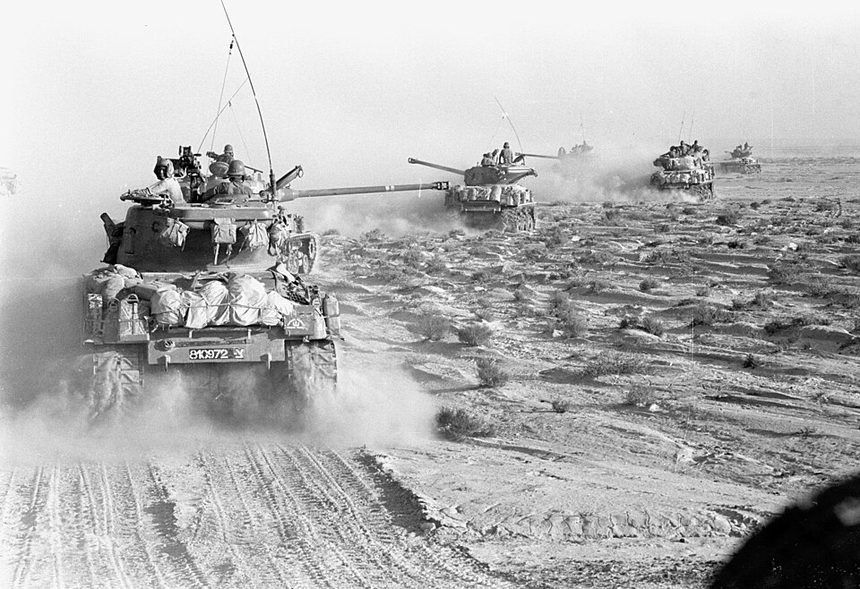
On raw force balance, the model gives Israel a 70% edge. How that verdict held up against history — below.
The balance of forces
| Israel | Egypt, Syria & Jordan | |
|---|---|---|
| 264,000 | Personnel | 330,000 |
| 800 | Tanks | 1,700 |
| 300 | Aircraft | 600 |
| ×1.35 | Quality factor (est.) | ×0.75 |
Fully mobilized reservist army, superbly trained pilots, one unified plan — versus — Three uncoordinated commands, air forces parked in neat rows.
What actually happened
Outnumbered two-to-one in tanks and planes, Israel destroyed the Egyptian air force on the ground in the war's first three hours — roughly 300 aircraft — and fought the rest of the week with total air supremacy. Sinai, the West Bank and the Golan fell in six days. The gap between the model's cautious edge and the actual rout measures exactly what surprise and training are worth.
All scenarios
- Operation Barbarossa (1941): Germany vs USSR
- Pacific War (1941): Japan vs United States
- Invasion of Poland (1939): Germany vs Poland
- Battle of France (1940): Germany vs Allies
- Korean War Outbreak (1950): North vs South
- → All scenarios
Figures are approximate campaign-start estimates from open historical sources; the quality factor is our editorial assessment of doctrine and training. Compare these countries' modern armies in the simulator.