 ARMY
ARMYKorean War Outbreak (1950): North vs South
1950
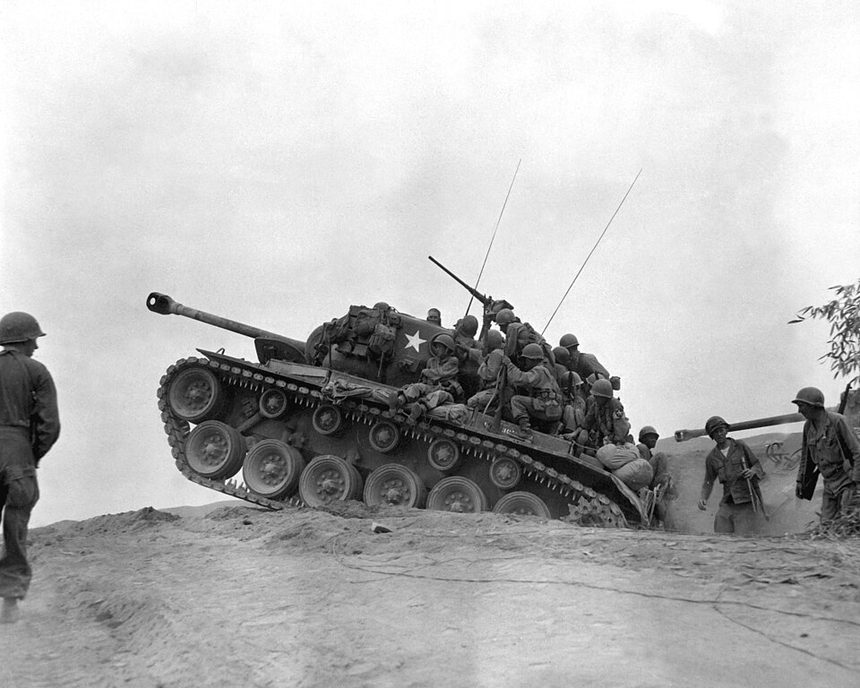
On raw force balance, the model gives North Korea a 78% edge. How that verdict held up against history — below.
The balance of forces
| North Korea | South Korea | |
|---|---|---|
| 198,000 | Personnel | 98,000 |
| 258 | Tanks | 0 |
| 172 | Aircraft | 22 |
| 1,600 | Artillery pieces | 700 |
| ×1.1 | Quality factor (est.) | ×0.85 |
Soviet T-34s and training, veterans of the Chinese civil war — versus — Constabulary force without tanks, anti-tank weapons or combat aircraft.
What actually happened
The model's verdict is emphatic, and June–August 1950 proved it: Seoul fell in three days and the South was compressed into the Pusan perimeter within weeks. What no force table shows is the outside world — the UN intervention, Inchon landing and Chinese counter-intervention turned a three-month rout into a three-year stalemate ending almost exactly on the original border.
All scenarios
- Operation Barbarossa (1941): Germany vs USSR
- Pacific War (1941): Japan vs United States
- Invasion of Poland (1939): Germany vs Poland
- Battle of France (1940): Germany vs Allies
- Six-Day War (1967): Israel vs Arab Coalition
- → All scenarios
Figures are approximate campaign-start estimates from open historical sources; the quality factor is our editorial assessment of doctrine and training. Compare these countries' modern armies in the simulator.